
Blog series: Beyond the Physical Aspects of Patient Support to Enhance Emotional, Spiritual, and Cultural Care
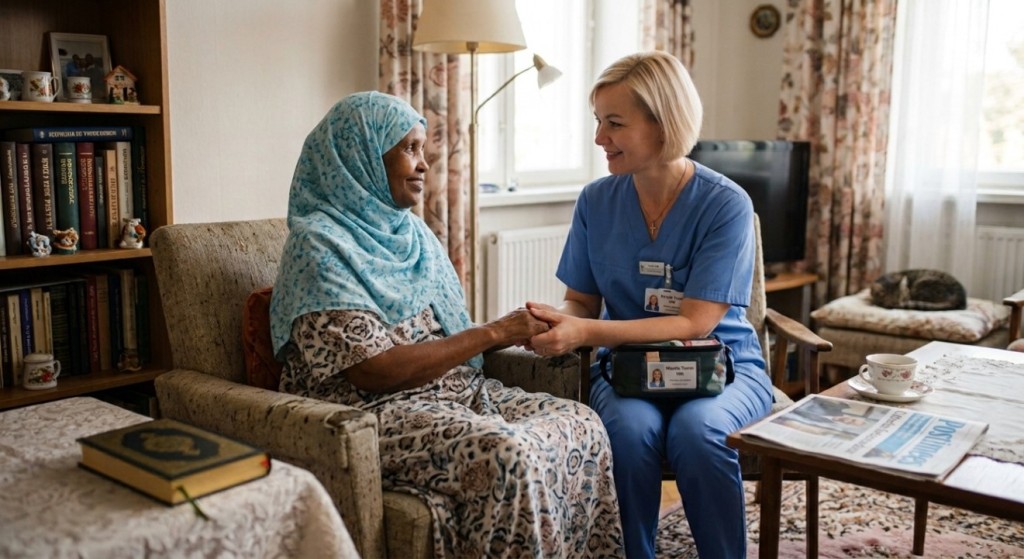
Blog series: Beyond the Physical Aspects of Patient Support to Enhance Emotional, Spiritual, and Cultural Care
Holistic healthcare extends far beyond physical symptoms, requiring deep awareness of a patient’s emotional, spiritual, and cultural background to improve patient trust and clinical outcomes. This comprehensive approach directly benefits older adults and helping professionals by fostering meaningful connections and reducing care barriers.
To deliver truly person-centered support, care teams must leverage crucial skills sets and theoretical frameworks. These include Emotional Intelligence (EI) and Empathic Accuracy (EA) to infer unspoken feelings, the Brief Religious Coping Scale framework to distinguish between positive and negative religious coping, and M. Leininger’s Transcultural Model alongside Giger and Haddad’s six phenomena to navigate diverse social and structural health influences.
Practitioners can immediately apply these insights by utilizing targeted screening questions for anxiety and mood, following socio-cultural checklists regarding language and diet, and monitoring spiritual vulnerability. Ultimately, clinical excellence relies on an empathetic professional-patient connection supported by ongoing collaboration with families and colleagues.
Author(s): Anne Ehasalu, MA, research fellow, Tallinn Health University of Applied Sciences
Liina Männiksaar, RN, MSc, teacher, Tallinn Health University of Applied Sciences
Lecture reference: Lecture 12: Assessing emotional, spiritual, religious and culturally competent care
Why Holistic Care Matters for Every Patient
Holistic care extends far beyond managing physical symptoms, requiring deep awareness of a patient’s emotional, spiritual, and cultural background. In an increasingly diverse society, healthcare and caregiving professionals must develop strong emotional intelligence (EI) and cultural competence to deliver truly person-centered support. When care teams recognize unspoken emotional struggles, respect unique religious coping mechanisms, and honor distinct cultural traditions, patient trust increases and health outcomes improve. This comprehensive approach directly benefits specially older adults, and helping professionals themselves by fostering meaningful clinical connections, reducing systemic care barriers, and elevating the overall quality of life for vulnerable individuals.
Core Concepts Covered: Integrating Emotional Intelligence, Spiritual Needs, and Cultural Competence
Achieving high-quality, holistic support relies on three vital pillars: emotional care, religious and spiritual assessment, and culturally competent practices.
Emotional Care: Emotional Intelligence (EI) serves as a foundational skill set built on self-awareness, self-regulation, motivation, social skills, and social awareness. Within professional care settings, Empathic Accuracy (EA) is particularly critical, representing a clinician’s precision in identifying and inferring a patient’s unspoken thoughts, feelings, and emotional expressions.
Religious and Spiritual Needs Assessment: It is essential to distinguish between religiosity (formal, institutional, and outward expressions) and spirituality (an individual’s personal journey to find existential meaning, interconnectedness, and transcendence). Individuals often rely on spiritual resources to cope with severe life distress. Providers can evaluate this through the , Brief Religious Coping Scale,
which differentiates between positive religious coping (seeking a stronger connection with God, love, and strength) and negative religious coping (feeling punished or abandoned by a higher power, or questioning divine love).
Cultural Competence: To effectively tailor support to diverse backgrounds, practitioners utilize frameworks like M. Leininger’s Transcultural Nursing Model (Sunrise Model) and Giger and Haddad’s six cultural phenomena. Leininger’s model focuses on how technological, religious, kinship, social, economic, educational, and political factors shape healthcare practices and decisions globally. Meanwhile, Giger and Haddad’s framework provides a clinical structure by analyzing six specific cultural phenomena: communication, space, social organization, time, environmental control, and biological variations. Both highlight how deeply an individual’s worldview shapes their health decisions and lifeways.
How Practitioners Can Apply These Holistic Tools in Daily Routines
Healthcare practitioners and caregivers can immediately implement these specific assessment criteria and conversational guidelines in their daily routines:
Psychological Domain Screenings: Integrate specific, direct questions into routine evaluations to gauge a patient’s mood and functional capacities. Useful questions include: “Do you feel anxious or worried about anything?” or “Are you able to concentrate on something, or are you easily distracted?”
Socio-Cultural Checklists: When evaluating or admitting an individual, systematically map out key parameters from established cultural assessment instruments:
- Ethnic origin, primary preferred languages, and the immediate need for an interpreter.
- Core support systems and primary family decision-makers.
- Specific dietary requirements and religious or cultural food restrictions.
- Cultural customs or taboos regarding personal space, eye contact, and physical touching.
Monitoring Spiritual Vulnerability: Listen closely to patient narratives for markers of negative religious coping. Expressing feelings of divine punishment or church abandonment indicates an urgent need for compassionate, non-judgmental validation.
Summary
True clinical excellence relies on a balanced, empathetic connection between a professional and their patient. By treating emotional intelligence and cultural awareness as essential clinical tools rather than optional soft skills, care teams can bridge communication gaps effectively. Navigating complex, multicultural situations requires regular consultation with patients, their relatives, and professional colleagues. Embracing these inclusive assessment practices ensures every individual receives respectful, dignified, and highly personalized care.
Keywords: Holistic nursing, Cultural competence, Emotional Intelligence, Spiritual care, Patient assessment.
References
Devkota R., Cummings G., Hunter, K. F., Maxwell, C., Shovana,S., Dennett,L., Hoben, M.(2023). Factors influencing emotional support of older adults living in the community: a scoping review protocol. Systematic Reviews, 12(1), 186.doi: 10.1186/s13643-023-02346-7
Flykt, A,. Hörlin, T., Linder,F., Wennstig, A‑K., Sayeler,G., Hess,U., Bänziger,T. (2021). Exploring Emotion Recognition and the Understanding of Others’ Unspoken Thoughts and Feelings when Narrating Self‑Experienced Emotional Events. Journal of Nonverbal Behavior, 45:67–81 https://doi.org/10.1007/s10919-020-00340-4
Jamieson H, Abey-Nesbit R, Bergler U, Keeling S, Schluter PJ, Scrase R, Lacey C. (2019). Evaluating the Influence of Social Factors on Aged Residential Care Admission in a National Home Care Assessment Database of Older Adults. J Am Med Dir Assoc. Nov;20(11):1419-1424. [PubMed] [Reference list] PMID: 30734275DOI: 10.1111/inr.12487
Kyung Eui Bae, Geum Hee Jeong (2023) Effect of a transcultural nursing course on improving the cultural competency of nursing graduate students in Korea: a before-and –after study EEHP; 20:35. Published online 4. December DOI: https:// doi.org/10.3352/jeeph.2023.20.25
Laukka, P., Elfenbein, H.A. (2020) Cross-Cultural Emotion Recognition and In-Group Advantage in Vocal Expression: A meta-analysis. Emotion Review, 13(1), 3-11. https://orcid.org/0000-0001-8771-6818 petri.laukka@psychology.su.se
Pargament, K., Feuille, M, Burdzy, D. (2011). THE Brief RCOPE: Current psychometric status of a short measure of religious coping. Religions, 2(1), 51-76.
Pop-Jordanova, N., Demerdzieva, A. (2015). Is the Level of Emotional Intelligence in Students and Health Workers Satisfactory? International Journal of Innovation and Research in Educational Sciences Volume 2, Issue 4, ISSN (Online): 2349–5219.
Puchalski, C. M., Dorff, R. E., & Hendi, I. Y. (2004). Spirituality, religion, and healing in palliative care. Clinics in geriatric medicine, 20(4), 689-714.
Vitale E., Lupo R., Calabro A., Lezz A., Zacchino S., Vergoris S., Carvello M., Valenzano I., Conte L., et.al. (2023). Transcultural Nursing in Italy: An Explorative Study. Nurs.Sci.Q. 36: 292 – 298.doi:10.1177/08943184231169769801
Wiltjer, H., & Kendall, N. (2019). Assessment of older people 4: assessing the psychological domain. Nursing Times, Vol 115 Issue 8;44-48.