
Blog series: Wounds, ostomies, and urinary catheters — what nursing students must know
Summary
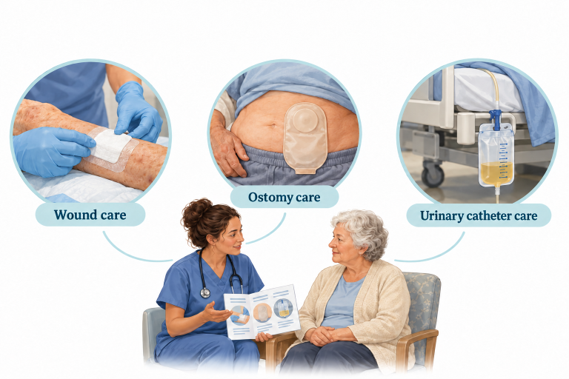
Care for older adults with wounds, ostomies, or urinary catheters combines assessment, practical care, and patient education. Understanding treatment goals and supporting usual activities are central to nursing practice. Within the BigPicture learning programme, Lecture 19 explored holistic care for older adults with wounds, ostomies, and urinary catheters, focusing on assessment, care and management, and patient education.
Author:
Jekaterina Šteinmiller PhD, Tallinn Health University of Applied Sciences, Estonia
Based on Lecture 19: Holistic Care for Wounds, Ostomies, and Urinary Catheters.
Why wounds, ostomies, and urinary catheters require special attention
Older people have a high risk of developing chronic wounds. Pressure ulcers and vascular wounds are among the most common, and chronic wounds can be considered a geriatric syndrome. Prevention, early diagnosis, and timely treatment therefore deserve attention in everyday care.
An ostomy or a long-term urinary catheter also brings practical questions into a patient’s daily life. Patients may need guidance about supplies, bathing, work, sex, social life, sports, or other activities. Nursing care needs to address these questions alongside the wound, stoma, or catheter itself.
Does the patient understand how to manage care and when to seek medical help?
For nursing students, this question connects practical skills with patient education. Completing a care activity provides an opportunity to assess problems, discuss discomfort, and check the patient’s understanding.
What you need to understand about wounds, ostomies, and urinary catheters
Wound care
The TIME principle provides a structure for considering four aspects of a wound: Tissue, Infection, Moisture, and Epithelial edge advancement. These aspects help organise attention during wound assessment.
Wound management also depends on the type of wound. The lecture identifies pressure reduction for pressure injury, compression therapy for venous wounds, and evaluation of arterial circulation. Protein supplements and consideration of biopsy are further topics in wound management. Treatment goals should remain realistic.
Patient education includes the dressing pack, wound care products, asepsis, antisepsis, and signs of infection.
Ostomy care
An ostomy reroutes bodily waste through a surgical procedure and may be temporary or permanent. The lecture introduces colostomy, ileostomy, and urostomy.
Patients may have concerns about how an ostomy will affect their usual activities. For a person with a colostomy, work, clothing, sex, and social life are relevant topics for discussion. A securely attached pouch supports participation in swimming and sports, while diet advice should follow the nurse’s recommendations.
Colostomy care includes handwashing before and after care, checking the stoma, preventing bowel movement leakage, and managing skin problems around the stoma. A hernia requires management as directed.
Long-term urinary catheter care
Urinary tract infections and blockages are important risks associated with a long-term urinary catheter. Assessment also needs to consider pain or discomfort and whether the patient understands catheter care.
The lecture highlights responsibility for monitoring the catheter and ensuring regular changes. Patient education should also address usual activities, sex, and when to seek medical help.
What you can apply in practice right away
Use a clear structure when assessing a wound.
Work through the TIME principle rather than focusing on only one aspect. Relate your observations to the wound type and the treatment goals.
Include patient education in wound care.
Discuss the dressing pack and wound care products. Check the patient’s understanding of asepsis, antisepsis, and signs of infection.
What does the patient need to understand before managing care at home?
Observe the stoma during colostomy care.
Wash your hands before and after care, check for problems, and pay attention to leakage and the skin around the stoma. Include bathing, supplies, and documentation in your care and education.
Make room for questions about living with an ostomy.
Ask which activities matter to the patient. Work, clothing, swimming, diet, sex, and social life may all need discussion.
Ask specific questions about the urinary catheter.
Are there signs or symptoms of a urinary tract infection? Is there pain or discomfort? Who monitors the catheter and its regular changes? Does the patient know how to care for it and when to seek medical help?
These questions help identify what needs further attention and what the patient needs explained.
How this shapes your future nursing practice
Care for wounds, ostomies, and urinary catheters requires you to connect assessment with the patient’s daily experience. A wound needs realistic treatment goals. A person with an ostomy may need support with supplies and usual activities. A patient with a urinary catheter needs an understanding of care, monitoring, and possible problems.
As your practical skills develop, keep patient education alongside them. Each care activity is an opportunity to observe, listen, explain, and document.
What have you observed, and what does the patient still need to know?
Keywords:
Older adults, wound care, chronic wounds, TIME principle, ostomy care, colostomy, urinary catheter, patient education
Funded by the European Union. Views and opinions expressed are however those of the author(s) only and do not necessarily reflect those of the European Union or the European Education and Culture Executive Agency (EACEA). Neither the European Union nor EACEA can be held responsible for them.
References
- Alam, W., Hasson, J., & Reed, M. (2021). Clinical approach to chronic wound management in older adults. Journal of the American Geriatrics Society, 69(8), 2327–2334.
- Fletcher, J. (2005). Wound bed preparation and the TIME principles. Nursing Standard, 20(12), 57–65.
- Naseh, L., Shahriari, M., Hayrabedian, A., & Moeini, M. (2023). Nurses’ viewpoints on factors affecting ostomy care: A qualitative content analysis. Nursing Open, 10(8), 5261–5270.
- Rosenberg, A., & McGee, M. (2023). Patient education for stoma patients. Seminars in Colon and Rectal Surgery, 34(2).
- NHS Trust. (2023). Living with urinary catheter.